Hammerex Guide
The Future Of The Trades: Will AI And Robots Replace Construction Workers?
Robots laying blocks. AI reading building plans. Drones surveying structures. The technology is already on construction sites. The question is no longer whether it works - it is when the numbers make sense for your trade, and whether you will be the tradesman who ignores it or the tradesman who learns how to work alongside it.
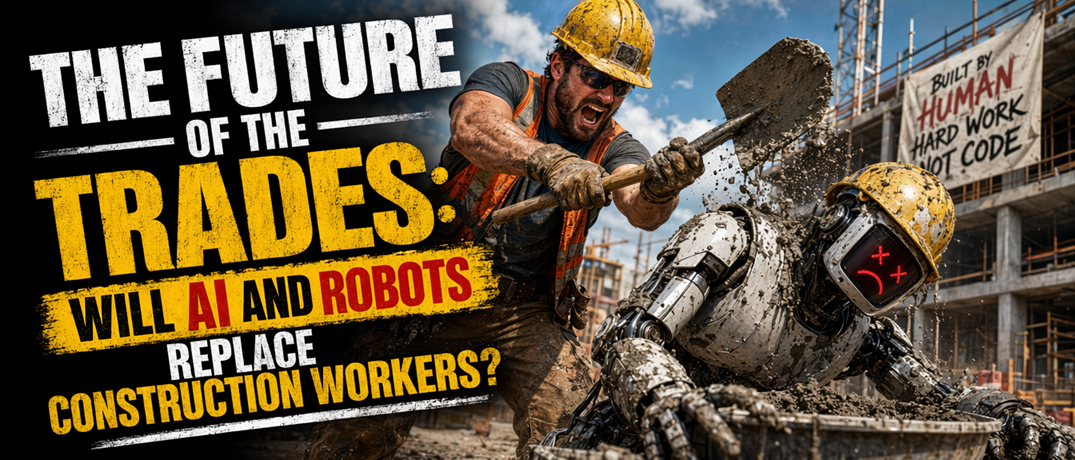
# The Future Of The Trades: Will AI And Robots Replace Construction Workers?
For years, the idea of robots taking over construction sites sounded ridiculous.
Most tradesmen would laugh at the thought.
A machine carrying scaffold tubes up ladders?
A robot laying blocks in the rain?
An AI system figuring out how to plaster around awkward corners or deal with twenty years of poor workmanship hidden behind a wall?
Not a chance.
At least that is what we thought.
But something has changed.
The conversation is no longer about whether technology can work on construction sites.
The conversation has become:
What price would make it worth doing?
The Future Arrived Years Ago
When most people hear the words AI and robotics, they imagine a two-legged metal machine walking around a building site.
But that is not where this story started.
AI has been quietly working for decades.
Factories have used automated systems for years.
Warehouses are filled with machines moving stock.
Manufacturing plants produce products with incredible precision using robotics and computer-controlled equipment.
Most people never noticed because they only saw the start button and the stop button.
The intelligence was hidden behind the machine.
Construction is simply the next industry facing the same question.
Why Construction Has Been Different
Construction has always been one of the hardest industries to automate.
A factory is controlled.
A building site is chaos.
Every project is different. Every location is different. Every weather condition is different. Materials vary. Designs change. Problems appear without warning.
One day you are working on a brand-new commercial development.
The next you are trying to make sense of a building that has been altered ten times over the last fifty years.
Human tradesmen adapt naturally.
Machines have struggled with that unpredictability.
But the gap is getting smaller.
The Robots Are Already Here
Many people imagine robots are still being tested in laboratories.
The reality is they are already working.
- Bricklaying robots can lay blocks faster than many human teams.
- Automated machinery can perform site surveys.
- Drones inspect structures and collect measurements.
- AI software identifies clashes in building designs before construction even begins.
- 3D concrete printers are producing structures layer by layer.
- Entire houses have already been built using automated construction systems.
The question is not whether the technology exists.
It does.
The question is how quickly it becomes affordable enough for widespread use.
What Happens When The Numbers Make Sense?
History shows that technology adoption usually comes down to one thing.
Cost.
When a machine can perform a task faster, safer, and cheaper than a human, businesses start paying attention.
Not because they dislike workers.
Because construction is a business.
Margins matter.
Deadlines matter.
Efficiency matters.
The moment technology becomes financially attractive, adoption accelerates.
That is what happened in manufacturing.
That is what happened in logistics.
That is what happened in agriculture.
Construction will not be immune forever.
The Trade Nobody Thinks Can Be Replaced
Every trade has someone saying:
That will never happen in my trade.
Scaffolders say it.
Plasterers say it.
Bricklayers say it.
Carpenters say it.
Electricians say it.
Plumbers say it.
And to be fair, many of them have a point.
Construction requires judgement. Problem solving. Adaptability. Communication. Experience.
These are incredibly difficult things to automate.
But history teaches us something important.
The first version does not need to be perfect.
It only needs to become good enough.
That is often when industries change.
What About The Next Generation?
If you are in your late thirties, forties, or fifties, you may never see complete automation of your trade.
You might spend your entire career working much as tradesmen do today.
But can we say the same for today's apprentices?
Can we say the same for the sixteen-year-old just entering construction?
Can we confidently predict what a building site will look like in twenty years?
The honest answer is no.
The speed of technological development is increasing.
What once took decades now happens within years.
And what once took years can now happen in months.
The Tradesman Of The Future
The future tradesman may look very different from today's tradesman.
He may still carry tools.
He may still work with his hands.
But he may also manage automated equipment. Interpret digital data. Program machinery. Operate AI-assisted systems. Coordinate robots performing repetitive tasks.
The worker who understands both the trade and the technology may become the most valuable person on site.
Not because he is replaced by technology.
Because he knows how to use it.
The One Thing Machines Cannot Replace
Every generation worries about technology replacing jobs.
Some jobs disappear. Others evolve. New opportunities emerge.
But one thing remains consistent.
Technology changes tools.
It does not eliminate the need for people who understand the work.
Machines may lay blocks. But who ensures the build is correct?
AI may create plans. But who identifies the practical issues?
Robots may carry materials. But who manages the project?
Technology changes how work is done. It rarely removes the need for skilled people entirely.
A Word From The Workshop
Hammerex has been part of UK trades for fifteen years. We have watched hand tools become power tools, paper drawings become digital plans, and string lines give way to laser levels. Each shift made tradesmen better, not redundant. AI and robotics will be the same story - the trades that adapt around new tools always survive the trades that hide from them.
The Clock Is Ticking
The biggest mistake any tradesman can make is assuming change is not coming.
The second biggest mistake is fearing it.
Construction has evolved for centuries.
Hand tools became power tools. Paper drawings became digital plans. Laser levels replaced string lines. Battery tools replaced cords.
Every generation experienced change.
The next wave simply happens to be AI and robotics.
The clock is ticking.
Not towards the end of the trades.
But towards the next version of them.
The question is not whether technology is coming to construction.
It is already here.
The real question is:
Will you be the tradesman who ignores it, or the tradesman who learns how to work alongside it?
Because the future of construction may not belong to robots.
It may belong to the people who know how to use them.